
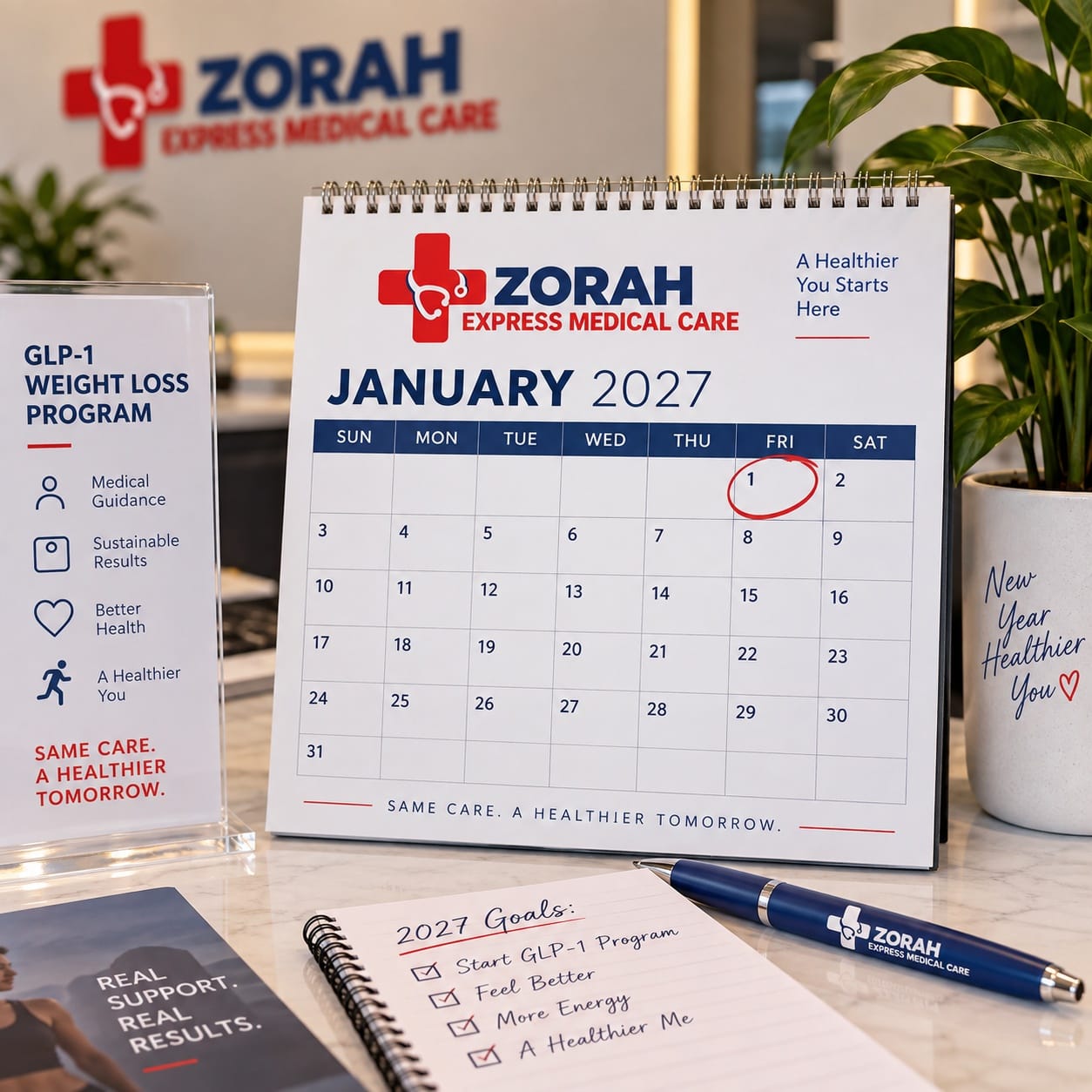
New Year, New GLP-1? A Physician’s Honest Guide to Starting at the Right Time, Surviving the January Rush, and Getting Through the First Ninety Days in Des Plaines and the Northwest Suburbs
By Dr. Naaz Aziz, MD, Board-Certified Family Medicine Physician · Zorah Express Medical Care · Updated September 2026
Zorah Express Medical Care · 1645 S River Rd, Suite 14, Des Plaines, IL 60018 · (708) 412-4040 · Monday–Saturday, 9–5 · book a new-year weight loss evaluation online — referrals not required.
Quick answer: The new year is a fine time to start a GLP-1 and the worst time to start one carelessly. January is the month clinics run resolution specials, waiting rooms fill, and the steps that keep the medication safe — a real exam, baseline labs, an honest talk about what the next year looks like — get skipped in the hurry. The better plan is to start when the evaluation is done properly, which for many patients means the fall or early winter, so that by January the dose is already working and the resolution is already underway. Whenever you start, expect the first two weeks to be the hardest, the scale to move in the first month, and the real result to build over three to six months of follow-up. In Des Plaines, that evaluation is a physician visit at Zorah: (708) 412-4040.
Why the Calendar Is the Wrong Doctor
Every year the same thing happens in my exam rooms. In November, patients tell me they will “start after the holidays.” In the first week of January, they arrive with a specific date in mind — often that day — and a specific number they want gone by a wedding, a vacation, or a reunion. I understand the impulse; a clean start is motivating, and motivation matters. But a resolution is a reason to make an appointment, not a medical indication. Whether a GLP-1 is appropriate for you is decided by your history, your exam, and your labs, and those do not change on January 1. What does change in January is the pressure on everyone involved to move fast, and moving fast is where the mistakes live.
What January Does to Clinics
January is the peak month for weight loss demand in this country, and the medical marketplace responds the way any market does. Telehealth companies run “new year” pricing. Med spas add GLP-1 to the menu. Some clinics book consultations fifteen minutes apart and send patients home with a prescription and a QR code. The shortages that made compounded semaglutide and tirzepatide a workaround are over — the FDA declared tirzepatide off its shortage list in December 2024 and semaglutide in February 2025, and the exemption that allowed mass compounding ended with them — but every January a wave of demand tests pharmacy supply again, and the operators who cut corners on sourcing are the ones with product in stock when others do not. A busy clinic in January is not a sign of a good clinic. It is a sign that it is January.
What January Does to Patients
It compresses everything. The patient who would normally ask three questions asks none, because the appointment was hard to get. The patient who has a family history that matters does not mention it, because the form was long and the line was longer. The patient who would never buy medication from an unnamed pharmacy does so, because the resolution has a deadline. And then the first two weeks arrive — the nausea, the flat appetite, the fatigue of eating less than the body is used to — on top of the coldest, darkest weeks of the year in the Chicago suburbs, and the medication that was going to change everything gets blamed for a bad month. Most abandoned resolutions are abandoned by February. Most abandoned GLP-1 prescriptions are abandoned in the same window, and for the same reason: no one prepared the patient for what the beginning feels like.
The Seven Things My January Patients Wish They Had Known
Wanting it is not qualifying for it. The decision belongs to a doctor who has actually examined you, and a clinic that will prescribe without an exam is telling you what kind of clinic it is. The beginning is the hardest part. Starting doses are deliberately low, the early loss is modest, and the side effects arrive before the results do; a patient who knows this stays, and one who does not quits. Nausea and a small appetite are the medication working, and both are managed with how and what you eat — small meals, protein first, no large fatty dinners, water all day. Labs are not optional. Thyroid, kidney and liver function, blood sugar, and a lipid panel before the first dose catch the conditions that make the medication unsafe and give you a baseline to measure against. This is a year, not a season. The medication is a long-term treatment for a chronic condition, and the plan for months six through twelve should be discussed before month one. Supply gets tight in January. Ask where the medication comes from and what happens if it is unavailable, before you start. Volume is not quality. The clinic with the shortest wait in January may be the one that spends the least time with you.
The Better Calendar: Start Before the Resolution
If you are reading this in the fall, the most useful thing I can tell you is that autumn is the ideal time to begin. A patient who has the consultation and labs in October and starts a low dose in November spends the holidays on a working medication with a smaller appetite, which is not a bad way to spend the holidays, and arrives in January already through the hard first weeks and already stepping up the dose. That patient’s resolution is not to start; it is to continue, and continuing is far easier. If you are reading this in January, the advice is the same in a different order: book the evaluation now, do it properly, and let the start date be whenever the labs are back. Two weeks of patience in January is not the difference between success and failure. Skipping the labs might be.
What the First Ninety Days Actually Look Like
Weeks one and two: the lowest dose, a smaller appetite within days, and for many patients some nausea or an unfamiliar fullness. The scale may move a few pounds, mostly water. This is the week to eat small, high-protein meals and to keep the follow-up date on the calendar. Weeks three to six: the first dose increase, side effects usually fading, and a visible change in how much food is on the plate. Loss becomes steady. This is also where the second-guessing starts, and a phone call to the clinic beats an internet search. Weeks six to twelve: a working dose, clothes fitting differently, and the first real conversation about what is being lost — because the goal is fat, and holding onto muscle through the winter means resistance exercise twice a week and protein at every meal, not just a smaller number. Month three is the first formal follow-up at Zorah, with repeat labs when indicated, a dose decision, and a plan for the next quarter.
Winter in the Northwest Suburbs Is Part of the Prescription
A GLP-1 started in January in Des Plaines faces a different January than one started in Phoenix. Daylight is short, the sidewalks are salted, and the easy walk after dinner is not happening. Vitamin D is low in nearly everyone I test in winter, and it matters for mood and energy on a medication that already dampens both for some patients. So the winter version of the plan is specific: a vitamin D level in the baseline labs and a supplement when it is low, an indoor activity that is actually going to happen — a gym on Oakton, a mall walk, a basement bike — and a protein target written down, because a smaller appetite in a cold month drifts toward crackers and coffee if no one is paying attention. Patients who set this up in the first visit do better in March than the ones who planned to “get moving when it warms up.”
How We Do It at Zorah, in January and Every Other Month
The same physician does the consultation, orders and reads the labs, writes the prescription, and sees you at month three, six, and twelve — that is me, and it is the same chart that holds your annual physical, your blood pressure, and, for patients who have it, your diabetes care, because weight loss is not a separate subject from the rest of your health. Medication sourcing is explained plainly and the pharmacy is named. The cost is quoted in writing, all-inclusive, after the consultation and labs rather than before, and our program options and what each includes are laid out on our medical weight loss guide for the Chicago suburbs. For the medications themselves — how they work, the doses, the side effects, the differences between semaglutide and tirzepatide — read my physician’s guide to GLP-1s. Patients who want the broader picture of metabolic care, including peptide therapy, will find it managed in the same practice, by the same doctor, alongside chronic disease management.
Who Comes to Us in January
Patients from Des Plaines first, and then the ring around it: Park Ridge and Niles next door, Rosemont and Mount Prospect, then Arlington Heights and Schaumburg farther out the tollway, and Jefferson Park and Norwood Park from the city side, most of them off I-90 or River Road, many of them on a Saturday. Some are new to the idea; some tried a telehealth subscription last January, lost weight for three months, ran out of medication or patience, and regained it by summer — the pattern we see most, and the one a physician-managed plan is built to prevent. My training is described at meet the doctor, and the experiences of patients who have been through this with us are on our patient reviews page.
Starting a GLP-1 in the New Year: What Patients Ask First
Is January a bad time to start a GLP-1?
No. It is a bad time to start one without an exam and labs. The timing is fine; the shortcuts are the problem.
Should I start before the holidays instead?
Often, yes. Starting in the fall means the hardest weeks are behind you by January and the holidays happen on a smaller appetite.
When does the scale start moving?
Appetite changes within days, the scale within the first month, and the meaningful result over three to six months as the dose reaches a working level.
What if the medication is out of stock in January?
Ask before you start where it is sourced and what the backup is. We name the pharmacy and plan for it.
Do I really need labs first?
Yes. They rule out the conditions that make the medication unsafe and give a baseline for the follow-ups.
What happens after the resolution wears off?
That is what the month-three, six, and twelve visits are for. The plan for the whole year is discussed at the first visit.
Is winter harder on a GLP-1?
A little. Less activity, less daylight, and low vitamin D are all planned for in the first visit.
What does it cost at Zorah?
A written, all-inclusive quote after the consultation and labs. The program options are on our weight loss guide linked above.
How do I get started?
Book online or call the clinic at 1645 S River Road, Suite 14, Des Plaines; we are open six days a week and no referral is required.
Start Right, Whatever the Date
The resolution is the easy part. The evaluation is what makes it work. Reserve your new-year weight loss visit with Dr. Aziz online, or reach the front desk at (708) 412-4040. We see patients on Saturdays.
Every GLP-1 carries risks and exclusions that differ from one patient to the next. What you have read here is general guidance on timing and expectations, not a prescription; only a licensed physician who has taken your history, examined you, and reviewed your labs can decide whether the medication is appropriate.