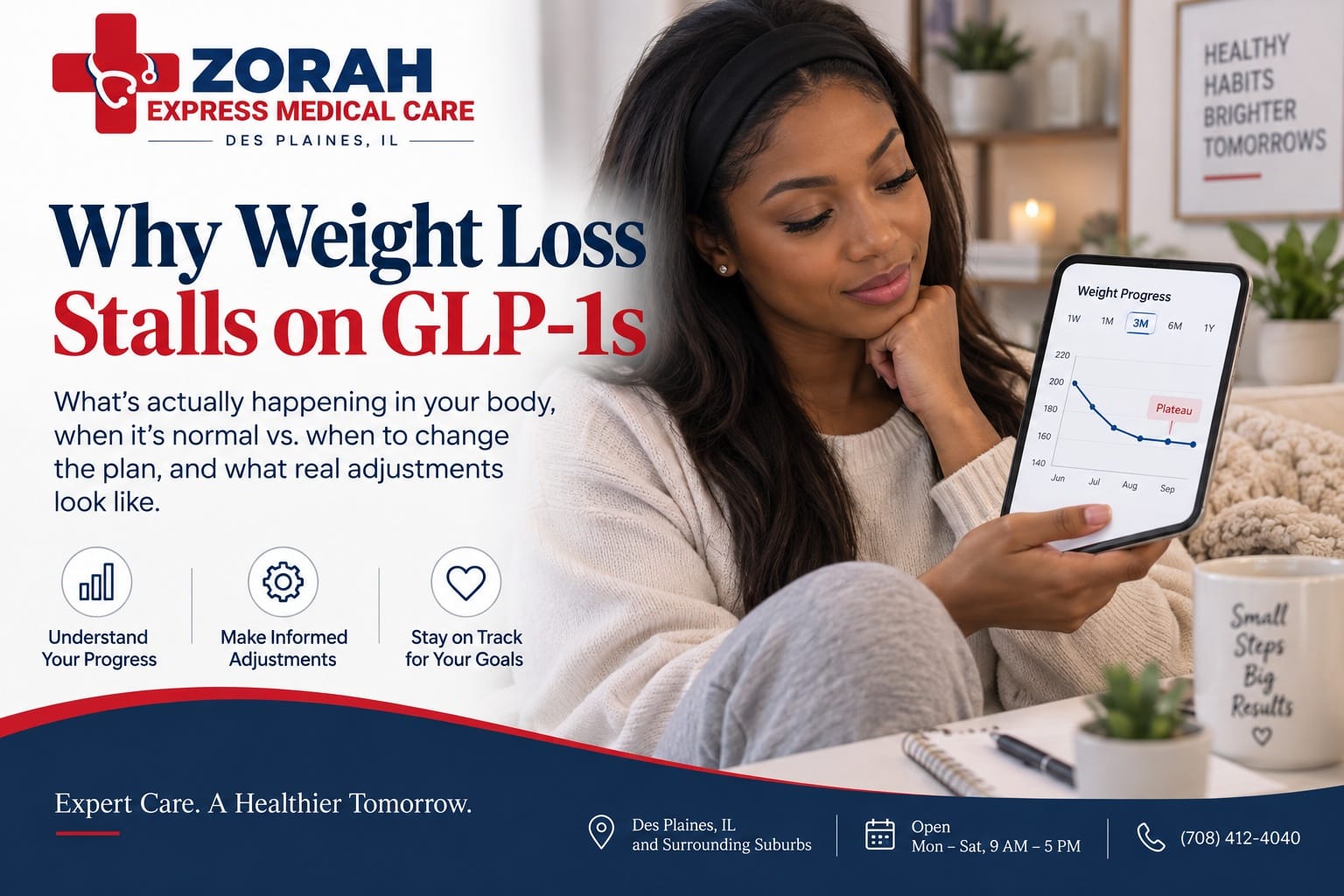

Why Willpower Isn’t the Real Variable, Who Actually Needs Medication vs. Who Doesn’t, and How That Decision Gets Made — A Physician’s Guide for Des Plaines, Park Ridge, Niles, and the Northwest Suburbs
By Dr. Naaz Aziz, MD, Board-Certified Family Medicine Physician · Zorah Express Medical Care, Des Plaines, IL · Updated September 2026
Zorah Express Medical Care — 1645 S River Road, Suite 14, Des Plaines, IL 60018, River Plaza Professional Building, off River Road near the Rosemont border, serving Des Plaines, Park Ridge, Niles, and surrounding suburbs. Open Monday through Saturday, 9 to 5. (708) 412-4040 · book a weight loss consultation online.
Quick answer: Diet and exercise work — but for a meaningful number of patients, they work against biology that’s actively fighting back, not just against habits that need fixing. GLP-1 medications like semaglutide and tirzepatide are appropriate for adults with a BMI of 30 or higher, or 27 or higher with a weight-related condition — not as a replacement for healthy habits, but because for many patients, the hunger and metabolic signals working against those habits are strong enough that medication is what makes the habits actually stick. Whether you need medication or not isn’t about how hard you’ve tried; it’s about what your specific biology is doing, and that’s determined at a real evaluation, not guessed at from a BMI chart alone.
Why “Just Try Harder” Isn’t the Full Picture
Weight regulation isn’t purely a matter of willpower — it’s governed by hormonal signals, including a gut hormone called GLP-1, that tell your brain when you’re full and regulate how quickly food moves through your digestive system. In many people with obesity, that signal is weaker or shorter-lived than it should be, which means hunger returns faster and satisfaction from meals doesn’t last as long — regardless of how disciplined someone is about food choices. This is the actual argument for medication in appropriate patients: it’s not a shortcut around effort, it’s a correction to a signal that isn’t working the way it should.
Who Diet and Exercise Alone Genuinely Work For
Plenty of patients successfully lose weight and keep it off through diet and exercise changes alone, particularly those with a lower BMI, no significant weight-related health conditions, and enough metabolic flexibility that appetite and hunger signals respond predictably to changes in food intake and activity. If you’re in this group, medication isn’t necessary and isn’t automatically the better choice just because it’s available — it’s a tool for a specific problem, not a universal upgrade.
Who Actually Benefits From Adding Medication
Medical weight loss with GLP-1 medications is appropriate for adults who meet specific criteria: a BMI of 30 or higher, or a BMI of 27 or higher with at least one weight-related condition — including type 2 diabetes, prediabetes, high blood pressure, high cholesterol, sleep apnea, PCOS, or joint disease. Many patients assume they don’t qualify because they’re not severely overweight, when in fact a lower BMI combined with a condition like prediabetes or hypertension often does qualify. This is also where the SELECT trial findings matter clinically, not just as a statistic — semaglutide has been shown to reduce major cardiovascular events by 20% in adults with obesity and existing cardiovascular disease, meaning for many patients, this isn’t a cosmetic decision, it’s a cardiovascular risk reduction strategy.
What a Real Evaluation Actually Looks Like
During your initial consultation, we review your complete health history, current medications, and lab results to determine whether medication is appropriate and, if so, which one and at what starting dose. This isn’t a form you fill out online — it’s a decision made after looking at your actual labs, your specific health conditions, and your history with weight loss attempts, since not everyone is a candidate for every medication. Proper screening is one of the most important things separating a real medical clinic from an online prescription service with minimal oversight.
Why the Rise of Telehealth-Only Options Raises the Stakes Here
The surge in demand for GLP-1 medications has led to a proliferation of telehealth-only weight loss services, online “clinics,” and med spas prescribing these medications with minimal oversight. Convenience has real value, but this approach comes with real risk: GLP-1 medications can cause nausea, vomiting, and gastrointestinal discomfort, particularly when doses are escalated too quickly without proper monitoring — exactly the kind of complication a supervised, in-person program is built to catch and manage before it becomes a reason to quit treatment altogether.
Medication Isn’t a Replacement for the Fundamentals
Even for patients who are excellent candidates for medication, diet and exercise don’t become irrelevant — they become more effective. A GLP-1 makes it easier to eat appropriate portions and stick to consistent habits, but protein intake and resistance training still determine whether the weight you lose is fat or muscle, and lifestyle changes built during treatment are what tend to make results last after treatment ends. Programs that include support for lean muscle preservation, like Amino Blend injections alongside dietary counseling, exist because medication and lifestyle changes work best together, not as substitutes for each other.
How This Decision Actually Gets Made
Start with an honest assessment rather than a decision made in advance. At your consultation, we’ll review your BMI, any weight-related conditions, your history with weight loss attempts, and relevant labs through your annual physical panel or targeted bloodwork. If you have an existing condition being managed through chronic disease management, that’s factored in directly, since weight loss medication decisions shouldn’t happen in isolation from the rest of your health picture.
Frequently Asked Questions
Do I need to be severely overweight to qualify for medication?
No. A BMI of 27 or higher with a weight-related condition like prediabetes, hypertension, or sleep apnea can qualify — many patients assume they don’t meet the threshold when they actually do.
Is medication just a shortcut instead of doing the work?
No. For appropriate candidates, medication corrects a hormonal signal that’s working against diet and exercise efforts, making those efforts more effective rather than replacing them.
Can I try diet and exercise first before considering medication?
Yes, and for many patients that’s entirely appropriate. The decision isn’t about trying medication first — it’s about identifying whether your specific situation includes factors that make medication meaningfully more effective for you.
Are online, telehealth-only GLP-1 services a safe alternative?
They carry more risk due to limited oversight, particularly around dose escalation and monitoring for side effects. In-person evaluation and follow-up matter for both safety and effectiveness.
Does insurance cover medical weight loss?
Coverage varies by plan and by whether you meet diagnostic criteria for conditions like diabetes. This is reviewed directly at your consultation.
Where are you, and how do I book a consultation?
1645 S River Road, Suite 14, Des Plaines, six days a week from 9 until 5. Book online or call; no referral needed.
Find Out What Your Specific Situation Actually Calls For
The right answer depends on your labs, your history, and your specific health picture — not a generic rule. Schedule a consultation or call (708) 412-4040. You can read more about our approach on our about page.
Zorah Express Medical Care · 1645 S River Road, Suite 14, Des Plaines, IL 60018 · (708) 412-4040 · Monday–Saturday, 9 AM–5 PM
GLP-1 medications carry risks and contraindications that vary by individual. This guide is educational; whether medication is appropriate for you is decided by a licensed physician after a consultation and evaluation.