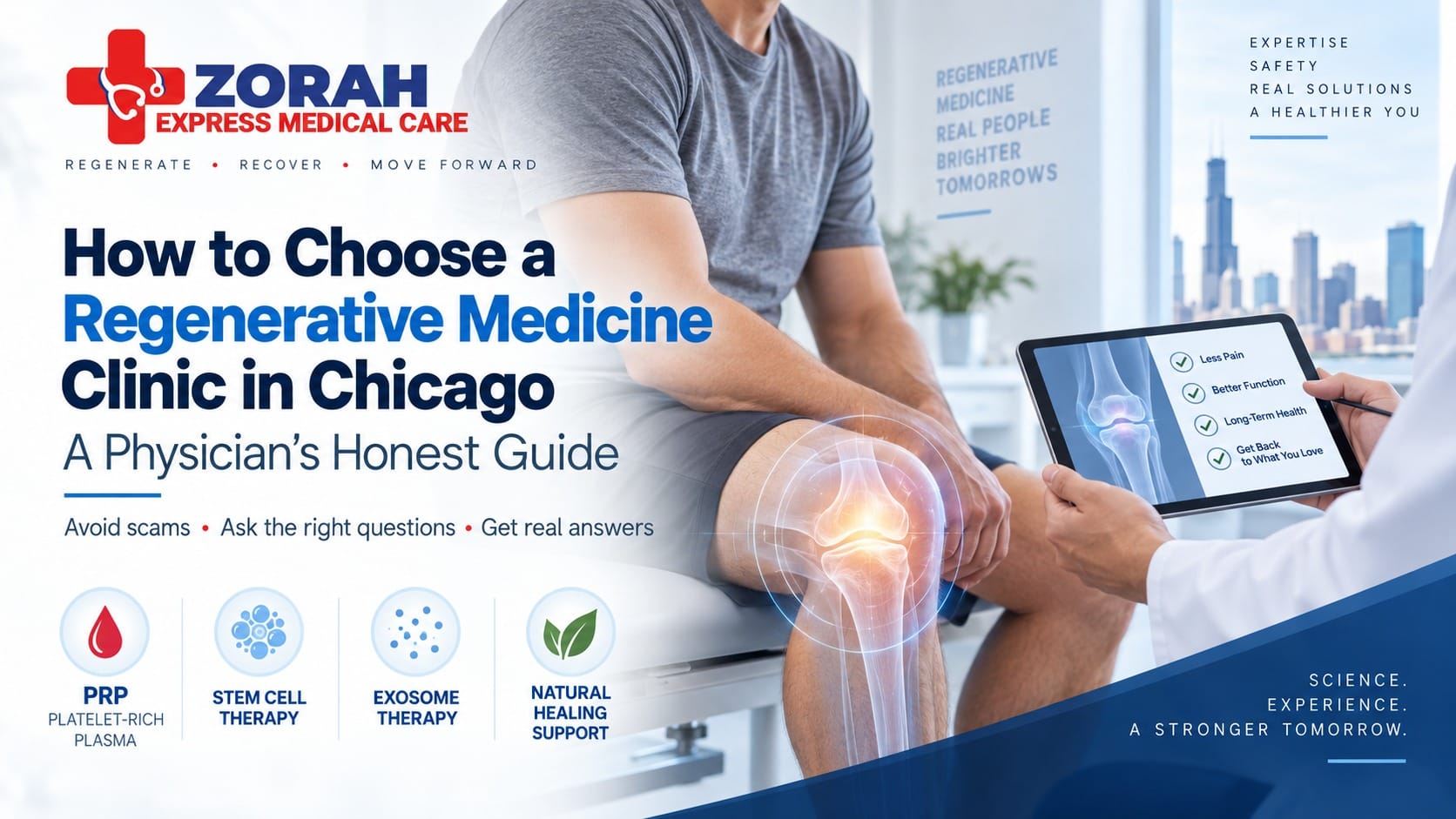
How to Choose a Regenerative Medicine Clinic in Chicago: A Physician’s Checklist — Seven Red Flags, Sixteen Questions to Ask, How to Verify Any Doctor in Illinois in Five Minutes, and What Honest PRP, Stem Cell, and Exosome Care Actually Looks Like
By Dr. Naaz Aziz, MD, Board-Certified Family Medicine Physician · Zorah Express Medical Care, Des Plaines, IL · Updated September 2026
Zorah Express Medical Care — PRP, stem cell, exosome, and peptide therapy, joint injections, and primary care under one physician — 1645 S River Road, Suite 14, Des Plaines, IL 60018, River Plaza Professional Building, 15 to 25 minutes from the Northwest Side and the O’Hare suburbs. Six days a week, 9 to 5, Monday through Saturday. (708) 412-4040 · schedule a regenerative medicine consultation online.
Quick answer: Choose a regenerative medicine clinic in Chicago the way you would choose a surgeon: confirm the physician’s license and board certification yourself, insist on a real consultation with an exam and imaging review before anyone quotes a price, demand written sourcing for any stem cell or exosome product and an honest statement of its FDA status, get the full cost and the follow-up plan in writing, and walk away from any clinic that guarantees results or pressures you to book the same day. At Zorah Express Medical Care in Des Plaines, every regenerative treatment is evaluated and performed by Dr. Naaz Aziz — board-certified, with 17-plus years of practice, in a clinic that also manages your primary care — which means we are the ones who tell you when a four-figure injection is not the right answer.
Why This Decision Is Harder in Chicago Than Almost Anywhere
Chicago has one of the densest regenerative medicine markets in the country. Academic centers run trials in the Loop and on the Near West Side. Boutique clinics in River North, the Gold Coast, and Lincoln Park sell stem cell packages next to Botox. Chiropractic offices in the suburbs advertise “stem cell seminars” with free dinners. Telehealth companies mail peptides after a video call. And a handful of medical practices quietly do the work well. From the outside, the billboards on the Kennedy and the ads in your feed all look the same, and the price tags run from a few hundred dollars for PRP to five figures for a stem cell series.
The Federal Trade Commission and the FDA have both taken action against regenerative clinics around the country for unsupported claims, and the FDA continues to publish warning letters to clinics marketing unapproved stem cell and exosome products. None of that stops the ads. The only protection you have is knowing what to check before you sit in the chair.
Seven Red Flags That Should End the Conversation
1. A guarantee. No one can promise you new cartilage, a reversed arthritis, or a guaranteed escape from surgery. PRP, stem cell, and exosome treatments can reduce pain and inflammation and support healing in the right tissue; they cannot rebuild a bone-on-bone joint. A clinic that guarantees an outcome is telling you what it thinks of your judgment.
2. A price before an exam. If you are quoted a number over the phone, or at a seminar, before a physician has examined the joint, looked at your imaging, and read your medication list, you are being sold a product, not treated for a condition.
3. No physician in the room. Ask who performs the procedure and who evaluated you. In Illinois, the person injecting a biologic into your knee should be a licensed physician or a clinician working under one on site — not a “regenerative specialist” with a certificate from a weekend course.
4. Vague sourcing. “Stem cells” is not an answer. The clinic should tell you exactly what is going in: your own fat (adipose-derived), your own bone marrow (BMAC), or a donor umbilical cord or amniotic product — and, for the donor products, the tissue bank and its registration. For exosomes, which lab, what protocol, and a plain acknowledgment that no exosome product carries FDA approval for any condition. A clinic that will not put that in writing does not want you to check.
5. The word “FDA-approved” used loosely. The only FDA-approved stem cell products are blood-forming products from cord blood, for specific blood and immune disorders. Orthopedic stem cell treatments, PRP, and exosomes are not FDA-approved drugs; some are lawfully offered under the tissue-product framework, others are not. An honest clinic says that plainly. A dishonest one says “FDA-approved lab” or “FDA-registered” and lets you hear what you want.
6. Pressure. Same-day discounts, “only three spots left at this price,” financing paperwork on the table before you have asked a question. A treatment that costs thousands and is not covered by insurance deserves a week of thought and a second opinion. Anyone who cannot wait a week is worried about what you will learn in it.
7. No follow-up plan. PRP is often a short series. Stem cell results build over two to three months and need to be assessed. If the plan ends when the card is charged, the clinic is not practicing medicine.
How to Verify Any Chicago Doctor in Five Minutes
Do this before every consultation, with every clinic, including ours. First, look the physician up on the Illinois Department of Financial and Professional Regulation license lookup: it shows whether the license is active and whether there is disciplinary history. Second, check board certification at the American Board of Medical Specialties’ Certification Matters site; “board-certified” is a specific claim and it is checkable. Third, search the FDA’s warning letter database for the clinic’s name. Fourth, read the Google reviews for the pattern, not the stars — specifically whether patients describe an exam and a conversation, or a sales pitch. Dr. Aziz’s credentials — American Board of Family Medicine, family medicine residency at UIC, 17-plus years of practice — are listed on the physician profile, and they check out at all three sources.
Sixteen Questions to Ask at the Consultation
About the physician and the clinic. Who exactly performs the procedure, and what is their license and specialty? How many of these procedures has this clinic done, and for how long? What is the physician’s training in regenerative medicine specifically? Is this clinic a medical practice, or a med spa or chiropractic office offering the procedure?
About the treatment. What does the research show for my condition, not for regenerative medicine in general? What is a realistic result for someone with my imaging and my history? What are the side effects, and how often do they happen? For stem cells or exosomes: what is the exact source, and what is its FDA status?
About the plan. What is the complete cost — consultation, imaging, the procedure, and every follow-up? How many treatments will I need, and how will we know whether the first one worked? What does follow-up consist of, and is it included? If it does not work, what then?
About the alternatives. What else could treat this — physical therapy, a steroid joint injection, a brace, weight loss, time? When would you tell a patient not to have this treatment? Is there a cheaper or less invasive option I should try first? If the physician cannot answer the last three, the clinic only sells one thing.
What Legitimate Regenerative Care Looks Like
A board-certified physician takes the history, examines the joint or the scalp or the skin, reviews the imaging, and only then discusses options — including the option of doing nothing yet. The sourcing of every biologic is stated in writing. The price is complete and on paper. The FDA status is discussed without spin. The expectations are realistic and no outcome is guaranteed. The follow-up visits are scheduled before you leave. And the treatment sits inside your broader health picture: your diabetes, your blood thinners, your weight, your blood pressure, all of which change what is safe and what will work.
That last point is where most Chicago clinics fall down. A stem cell boutique does not manage your A1c. A chiropractor cannot adjust your anticoagulant. At Zorah, the physician performing your PRP, stem cell, or exosome procedure is a family medicine physician who can also manage the diabetes, the cardiovascular risk, and the musculoskeletal problem underneath it, in one chart. If the honest answer to your knee is losing 30 pounds first, our medical weight loss program is down the hall, not across town.
What Each Treatment Costs, and What Insurance Does
Every clinic prices differently, and we quote after the exam, not before, for the reasons above. But you should walk in knowing the shape of it. PRP is the least expensive option and usually runs in the hundreds per session; a joint may need one to three, hair and skin a series. Stem cell procedures are priced in the thousands and vary with the source — your own fat or marrow involves a harvest and processing in the same visit; donor products do not. Exosomes fall between. Steroid injections are the least expensive and are often covered by insurance. PRP, stem cell, and exosome treatments generally are not covered, which is exactly why the written, all-inclusive quote matters: consultation, any imaging, the procedure, and the follow-up visits, with nothing added at the desk. Our consultation itself, and the exam and imaging review that come with it, are ordinary medical visits that your plan may cover.
How to Decide, in Order
Name the actual problem — a specific joint, thinning hair, skin texture, slow recovery — not “regenerative medicine.” Try the conservative options if you have not: physical therapy, activity changes, a steroid injection, weight loss. Get a real consultation, with the questions above in hand. Take a week. Get a second opinion if the quote has a comma in it. Then choose the clinic where the physician answered the “when would you not do this” question without flinching. Our sister article on regenerative medicine in Des Plaines explains what each treatment actually is and which goal it fits, if you want the treatment-by-treatment detail before your visit.
Why Chicago and Northwest-Suburb Patients Choose Zorah
One physician, board-certified, evaluates you and performs the procedure. Five regenerative options — PRP, stem cell, exosome, peptide therapy, and steroid injections — in one clinic, so the recommendation is not limited to whatever the clinic happens to sell. Sourcing stated in writing; FDA status stated plainly; pricing complete before you decide; follow-up scheduled before you leave. Primary care in the same chart. Saturday hours. 69 Google reviews averaging 4.9 stars, and more on our reviews page. Patients reach us from Jefferson Park, Norwood Park, Edison Park, Lakeview, Lincoln Park, and the rest of the Northwest Side, and from Rosemont, Park Ridge, Niles, Harwood Heights, Elmwood Park, Glenview, Mount Prospect, Arlington Heights, and Schaumburg — a straight run up I-90 or River Road to the River Plaza building.
Choosing a Regenerative Medicine Clinic in Chicago: Questions Patients Ask Us
Is stem cell therapy FDA-approved?
Only blood-forming stem cell products from cord blood, for certain blood and immune disorders. Orthopedic stem cell treatments are not FDA-approved drugs; a clinic should say so and explain under which framework it offers them.
Are exosome treatments FDA-approved?
No. The FDA has approved no exosome product for any disease or condition and has issued consumer alerts about unapproved ones. That does not mean every exosome product is dangerous; it means you need to know exactly what is being used and to be told the truth about its status.
How do I check whether a Chicago doctor is board-certified?
Look them up at the American Board of Medical Specialties’ Certification Matters site, and check their Illinois license on the IDFPR license lookup. Both take a minute and both are free.
Does insurance cover regenerative medicine?
Steroid joint injections often are covered. PRP, stem cell, and exosome procedures usually are not. The consultation and any imaging are regular medical visits and may be covered.
How much does PRP or stem cell therapy cost in Chicago?
PRP generally runs in the hundreds per session; stem cell procedures in the thousands, depending on the source. Insist on one written quote that includes consultation, imaging, procedure, and follow-up before you compare clinics.
How many treatments does it take?
PRP for a joint is often one to three; PRP for hair or skin is a series with maintenance. Stem cell is usually a single procedure with results assessed over two to three months. The honest number comes after the exam, not before.
Who should not have regenerative treatments?
Patients with active infection, certain cancers, blood disorders, or on some blood thinners; patients whose joint is bone-on-bone and needs a surgeon; and patients whose problem has a cheaper, proven answer they have not tried. A good clinic screens for all of these.
What is the difference between a regenerative clinic and a med spa or chiropractor offering PRP?
Whether a physician evaluated you and performs the procedure, whether the clinic can manage your other conditions and medications, and whether it will tell you not to have the treatment. Ask all three.
What does Zorah charge?
We quote after the consultation, in writing, all-inclusive. The consultation is an ordinary medical visit that many plans cover.
Where are you, and how do I book?
1645 S River Road, Suite 14, Des Plaines, IL 60018, open 9 to 5 every day but Sunday. Book online or call; new patients are welcome and no referral is needed.
Bring This List to Every Consultation — Including Ours
The right clinic will be glad you did. Schedule a regenerative medicine consultation with Dr. Aziz online or call (708) 412-4040, and bring your imaging, your medication list, and your questions.
Exosome products are the subject of FDA consumer safety alerts, and orthopedic stem cell treatments are generally not FDA-approved. This guide is educational; whether any treatment is right for you is decided by a licensed physician after an exam and imaging review.