By Dr. Naaz Aziz, MD — Board-Certified Family Medicine, Zorah Express Medical Care, Des Plaines, IL
If you live in Des Plaines and you have spent any time online looking up treatments for knee pain, shoulder problems, hair loss, or recovery from an injury, you have probably run into a long list of confusing options. PRP. Stem cells. Exosomes. Peptides. Cortisone. Each one comes with its own claims, its own price tag, and its own marketing language. Most patients walk into our clinic with the same opening line: “I’ve been reading about all this stuff and I have no idea what’s actually right for me.”
Fair. The regenerative medicine space has exploded over the past decade, and the result is a lot of clinics offering a lot of treatments without ever stopping to explain what they actually do, when they work, and when they do not. So I want to write the article I wish more patients had read before they walked into a consultation. This is the straight answer, from a real physician who performs these procedures every week, written for patients in Des Plaines and the surrounding Chicago suburbs.
By the end of this article, you should understand what regenerative medicine actually is, how the major options compare, who tends to be a good candidate for each, and how to figure out which path makes sense for your situation.
What Is Regenerative Medicine, Really?
Regenerative medicine is a category of treatments that work with the body’s natural healing processes rather than masking symptoms or cutting tissue out. Instead of just calming inflammation or replacing a worn joint, regenerative therapies aim to support the cells, signals, and structures that the body already uses to repair itself.
The core idea is not new. Your body has been healing cuts, mending bones, and rebuilding tissue your entire life. What is new is the science of helping that process along in a clinical setting using your own cells, your own blood components, or carefully sourced biological signals.
In our Des Plaines clinic, regenerative medicine usually comes up in three contexts:
- Joint pain and orthopedic problems — knees, shoulders, hips, tendons, and back pain that has not responded to standard care
- Aesthetics and hair restoration — skin quality, fine lines, thinning hair
- Recovery, performance, and healthy aging — peptide therapies and metabolic support
The treatments are different. The science behind each is at a different stage of maturity. And the right answer for you depends on what you are trying to fix and what evidence actually supports.
Let’s go through the major options one at a time.
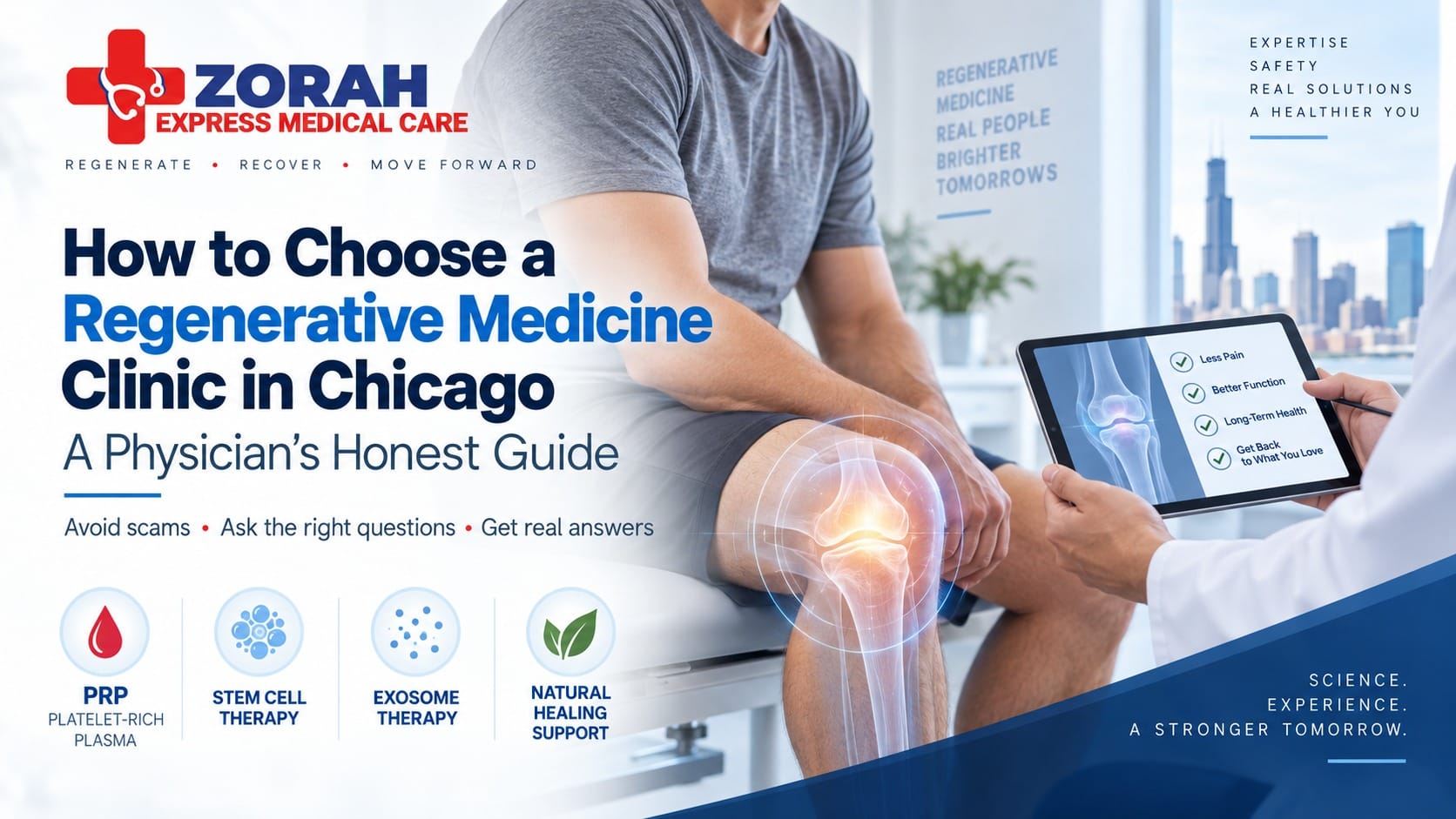
PRP: The Most Established Regenerative Option
PRP, or platelet-rich plasma, is the regenerative treatment with the longest track record. It has been used in orthopedic and aesthetic medicine for over two decades, and the research is solid for several specific uses.
The procedure is straightforward. We draw a small amount of your blood, spin it in a centrifuge to concentrate the platelets, and inject the concentrated PRP at the area being treated. Platelets are not just for clotting. They contain dozens of growth factors that signal your body to repair tissue, build collagen, and recruit healing cells.
PRP works best for:
- Knee osteoarthritis, particularly mild to moderate cases
- Tennis elbow and golfer’s elbow
- Certain rotator cuff and shoulder conditions
- Plantar fasciitis and Achilles tendinopathy
- Hair restoration in early-to-moderate pattern thinning
- Skin rejuvenation when combined with microneedling (sometimes called the vampire facial)
PRP is generally the first regenerative option I recommend when a patient is a good candidate, because the research is the strongest, the safety profile is excellent (it is your own blood, after all), and the cost is more accessible than newer regenerative treatments. If you are curious about specific uses, our PRP therapy page walks through joint, hair, and aesthetic applications in detail.
Stem Cell Therapy: The Bigger Hammer
Stem cell therapy uses concentrated regenerative cells to support tissue repair. Unlike PRP, which delivers signaling molecules, stem cell therapy delivers actual repair cells.
The most common sources of stem cells used in clinical practice are:
- Adipose-derived stem cells — taken from your own fat tissue
- Bone marrow aspirate concentrate (BMAC) — taken from your own bone marrow, usually the hip
- Umbilical cord and amniotic tissue products — donor-sourced, with their own regulatory considerations
Stem cell therapy is typically considered for patients with more advanced joint conditions, soft tissue problems that have not responded to PRP, or situations where the body needs more than just signaling support. It is more involved than PRP — the procedures take longer, the cost is higher, and the recovery is a bit more nuanced.
I am also honest with patients about the regulatory landscape. Most stem cell therapies for orthopedic use are not FDA-approved in the same way medications are, and there are clinics out there making promises that the science does not support. The right approach is honest evaluation, transparent discussion of sourcing, and realistic expectations. Our stem cell therapy page goes deeper into the different types and how we approach the conversation.
Exosome Therapy: The Newest Option
Exosomes are tiny vesicles that cells use to send signals to other cells. Inside each exosome are growth factors, proteins, and signaling molecules that tell other cells what to do — repair tissue, calm inflammation, support healing.
Where stem cells are the workers, exosomes are the messages those workers send out. Exosome therapy uses these signaling vesicles, derived in specialized labs, to deliver healing instructions to the area being treated.
Exosome therapy is the newest of the major regenerative options, and the science is genuinely exciting. It is also the most regulatorily complicated. The FDA has issued public safety alerts about unapproved exosome products, and currently there are no FDA-approved exosome products for the treatment of any disease or condition. That does not mean exosome therapy is dangerous when delivered properly — it means clinics offering it need to be transparent about what they are using, where it comes from, and what the realistic expectations are.
When patients ask me about exosomes, my answer is usually: let’s talk about what you are actually trying to treat first. For some situations, exosomes are a reasonable option. For others, PRP or stem cell therapy makes more sense. We walk through all of this honestly during the consultation, and our exosome therapy page covers the FDA framing in detail.
Peptide Therapy: A Different Category Entirely
Peptide therapy is sometimes lumped in with regenerative medicine, but it works differently. Peptides are short chains of amino acids that act as signaling molecules. Some are systemic — they affect the body as a whole. Others target specific tissues.
The most well-known peptides today are the GLP-1 medications used for weight loss and type 2 diabetes — semaglutide (Ozempic, Wegovy) and tirzepatide (Mounjaro, Zepbound). These have transformed how we approach obesity and diabetes management, and they are a big part of our work at the clinic, especially through our Chicago suburbs medical weight loss program.
Beyond GLP-1, peptides like Sermorelin, CJC-1295, and Ipamorelin are used to support natural growth hormone release for sleep, recovery, and healthy aging. BPC-157 has been discussed for tissue repair, though it has its own regulatory complications. GHK-Cu is a copper peptide used in skincare and hair contexts.
Peptide therapy is appropriate for patients whose goals are systemic — weight loss, recovery, sleep, energy, healthy aging — rather than fixing a specific joint. For patients trying to address a single bad knee or a sore shoulder, peptides are usually not the primary tool. Our peptide therapy page walks through which peptides we offer and how the consultation process works.
And Then There Are Cortisone Shots
I want to mention steroid joint injections in this guide because they are still a major part of how we treat joint pain, and patients often think the question is PRP vs cortisone when really both have a role.
Cortisone shots are powerful anti-inflammatories. They reduce swelling, calm inflamed tissue, and provide pain relief that can last weeks to months. They are well studied, widely covered by insurance, and clinically routine. They are not regenerative — they do not heal tissue — but they often provide the relief a patient needs to make progress with rehab, stay active, or get through a flare-up.
For some patients, a steroid joint injection is the right first step. For others, jumping directly to PRP or stem cells makes more sense. Sometimes the best plan combines both. The point is not to pick a side. The point is to figure out what fits your situation.
How to Decide: The Real Question
Here is what I tell patients in Des Plaines who are sitting in my office trying to figure out what to do:
The right regenerative treatment depends on five things:
- What you are trying to treat. A bad knee with arthritis is a different problem than thinning hair, which is a different problem than slow recovery in your fifties.
- How severe the condition is. Mild knee arthritis often responds beautifully to PRP. More advanced cases may benefit from stem cell therapy or even point toward orthopedic evaluation.
- What you have already tried. If you have done physical therapy, anti-inflammatories, and steroid injections without lasting relief, regenerative options become more relevant. If you have not tried any conservative care, that is usually the first step.
- Your timeline and budget. Regenerative treatments take time to work, and most are not covered by insurance. PRP is generally more accessible than stem cells or exosomes.
- Your overall health and goals. A patient managing diabetes, recovering from injury, or planning a long active retirement has a different starting point than a 30-year-old athlete recovering from a single tendon strain.
This is why a real consultation matters. A clinic that hands you a price list before asking you a single question is not a clinic that is going to figure out what fits your situation. The consultation is where you find out whether regenerative medicine is even the right path — or whether the answer is physical therapy, weight management, a different specialist, or something else entirely.
Why Des Plaines Patients Choose Zorah Medical for This Conversation
Regenerative medicine is having a moment. Clinics are popping up all over the Chicago suburbs, and the marketing language is loud. What we offer at Zorah Medical is something different: a board-certified family medicine practice that performs all of these treatments under one roof, run by a physician who will tell you honestly when a treatment is not the right answer for you.
A few specific reasons patients in Des Plaines, Park Ridge, Mount Prospect, Niles, Arlington Heights, and the broader Chicago area choose us:
- All five regenerative options (PRP, stem cell therapy, exosome therapy, peptide therapy, steroid joint injections) performed in one clinic by one physician
- Honest evaluation that includes when not to do a procedure
- Transparent discussion of FDA status, sourcing, costs, and realistic expectations
- Coordination with primary care, diabetes management, and weight management so your treatment fits into the bigger picture of your health
- Local clinic on South River Road, easy to reach for the multiple visits good regenerative care often involves
The point is not to sell you the most expensive option. The point is to figure out what fits your situation honestly and follow through with the level of care that gets real results.
What to Do Next
If you have been dealing with joint pain, recovering from an injury that will not heal, watching your hair thin, or just trying to figure out what regenerative medicine could do for you — start with a consultation. Bring your questions. Bring your imaging if you have it. Bring the list of things you have already tried.
We sit down, we talk it through, and we figure out the right plan together. Sometimes the answer is one of the regenerative options I have walked through here. Sometimes it is something simpler. Sometimes it is a referral to a specialist. The point is to give you honest answers and a path forward.
Call (708) 412-4040 or book online to schedule your regenerative medicine consultation in Des Plaines.
Quick Reference: Which Treatment for Which Goal?
For readers who want the short version:
- Mild to moderate joint arthritis or tendon problems → Often PRP first
- More advanced joint conditions or PRP that did not work → Consider stem cell therapy
- Acute inflammatory flare-up of arthritis or bursitis → Cortisone injection often appropriate
- Hair thinning in early to moderate stages → PRP for hair restoration
- Skin quality and aging concerns → PRP combined with microneedling (vampire facial) at our aesthetics and med spa
- Weight loss with metabolic support → GLP-1 peptide therapy and our medical weight loss program
- Recovery, sleep, energy, and healthy aging → Sermorelin, CJC-1295, Ipamorelin, and other peptides
- Looking for the newest regenerative option → Exosome therapy, with honest FDA framing during the consultation
Zorah Express Medical Care is a board-certified family medicine practice led by Dr. Naaz Aziz, MD, located at 1645 S River Rd, Suite 14, Des Plaines, IL 60018. Regenerative medicine consultations are physician-supervised and tailored to your individual situation. Individual results vary. This article is for informational purposes only and does not constitute medical advice. Please consult with a qualified physician before pursuing any regenerative medicine treatment.