Confidential STD Testing in Des Plaines: What Gets Tested, When to Test After an Exposure, How Fast Results Come Back, and How Treatment Happens the Same Visit — A Physician’s Guide for Des Plaines, Park Ridge, Niles, Rosemont, and Chicago’s Northwest Side
By Dr. Naaz Aziz, MD, Board-Certified Family Medicine Physician · Zorah Express Medical Care, Des Plaines, IL · Updated September 2026
Zorah Express Medical Care — confidential STD and STI testing, same-visit treatment, and PrEP — 1645 S River Road, Suite 14, Des Plaines, IL 60018, off River Road near the Rosemont border, ten minutes from O’Hare. Open Monday–Saturday, 9–5. (708) 412-4040 · book a confidential STD test online — no referral, no explanation required.
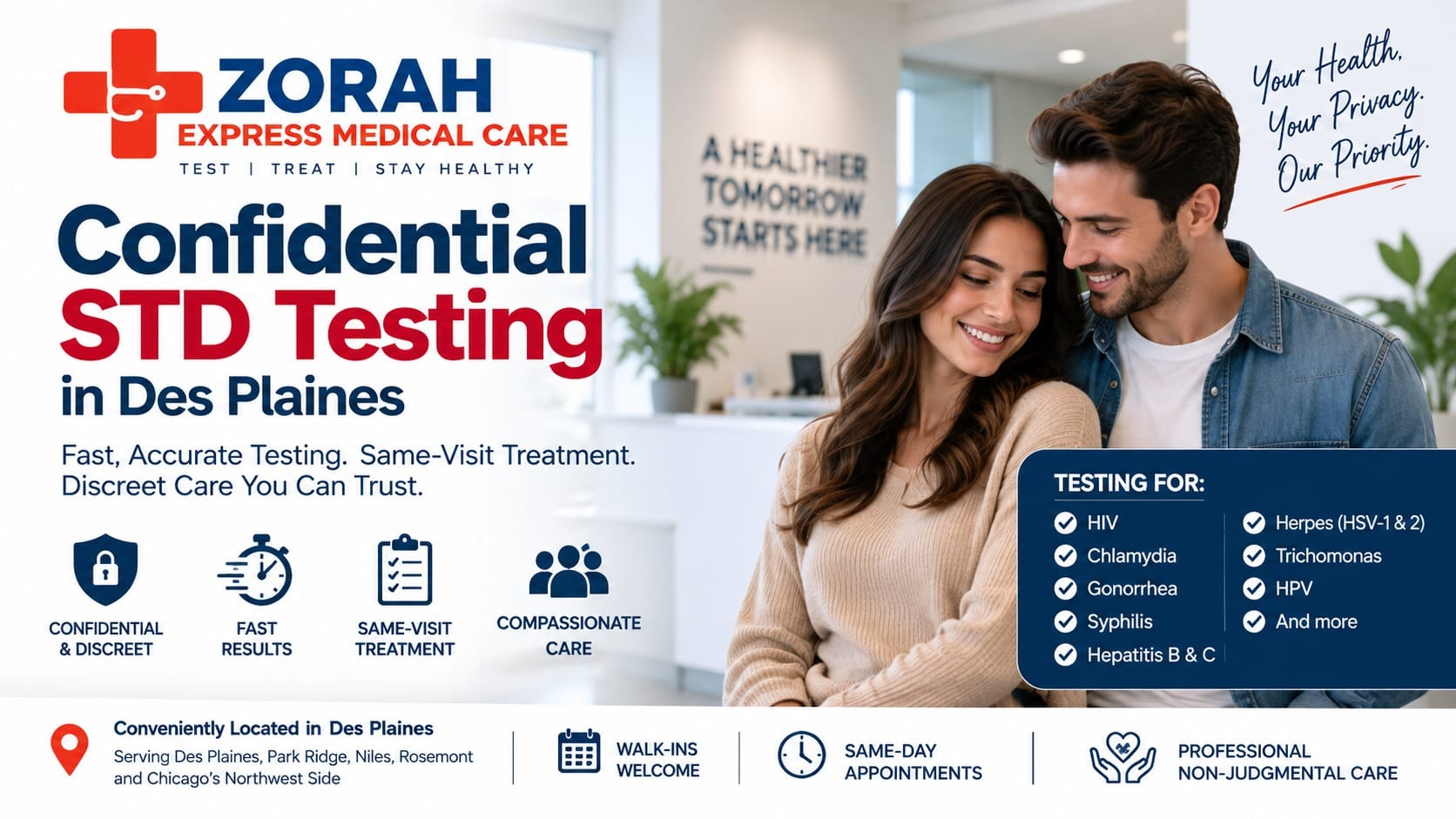
Quick answer: You can be tested for every common STD in Des Plaines this week, by a board-certified physician, in a private exam room, with results returned to you directly and treatment started the same visit when it is needed. Zorah tests for gonorrhea, chlamydia, trichomonas, syphilis, HIV, hepatitis, HPV, herpes, and Mycoplasma genitalium with urine, blood, and swab tests chosen for your situation; most infections are curable with a prescription written before you leave, and the rest are manageable. Testing is confidential, in Illinois anyone 12 or older can be tested and treated without a parent’s permission, and no referral is needed. Book online or call (708) 412-4040.
Why People in the Northwest Suburbs Put Off the Test, and Why This Week Is Better
Most people who search for STD testing near Des Plaines have been thinking about it for days. A new partner, a partner who was not honest, a condom that failed, a symptom that might be nothing, a text from an ex — and then the reasons not to go: it will show up on the insurance, the doctor will judge, the results take forever, the clinic is in the city, the walk-in will be full of people who know my family. Every one of those has an answer, and the answer to all of them is the same: the sooner you test, the simpler this is. Chlamydia and gonorrhea are cured with a single course of antibiotics when they are caught, and cause pelvic inflammatory disease, infertility, and chronic pain when they are not. Syphilis is curable with one injection early and a serious illness late. HIV caught early is a manageable condition with a normal life expectancy. The test is the easy part; the waiting is what does the damage.
What We Test For, and How
The panel is chosen for you, not pulled off a shelf. Chlamydia and gonorrhea are tested by urine, and by throat or rectal swab when those sites were exposed, because a urine test alone misses infections in the throat. Trichomonas by urine or swab. Syphilis, HIV, and hepatitis B and C by a blood draw. Herpes by a swab of an active sore, which is the accurate test, or by blood when there is no sore and a reason to look. HPV through cervical screening for women and examination of any visible warts. Mycoplasma genitalium, the infection most clinics do not think to test for and the one behind a lot of “my chlamydia test was negative but the symptoms are still there,” by urine or swab. And when a woman has pelvic pain, fever, or discharge, an exam for pelvic inflammatory disease, which is a complication that needs treatment the same day. The full list is on our STD care page; this article is about how the visit actually goes.
When to Test After an Exposure: The Window Periods
Testing the morning after an exposure feels responsible and tells you almost nothing, because every infection needs time to become detectable. Chlamydia and gonorrhea show up reliably one to two weeks after exposure. Syphilis takes three to six weeks, sometimes up to three months, to show on a blood test. HIV on the modern fourth-generation test is detectable from about 18 days and reliably by 45; a negative at six weeks is reassuring and a negative at three months is definitive. Hepatitis B and C take weeks to months. A herpes blood test needs twelve to sixteen weeks. So the right plan after a single worrying exposure is usually two visits: one at about two weeks for chlamydia, gonorrhea, and trichomonas, and one at six weeks for the blood tests, with a three-month HIV check if the exposure was high-risk. If there are symptoms, come in now regardless of the calendar. And if the exposure was within the last 72 hours and HIV is a real possibility, that is an emergency for a different reason — see the PEP section below.
How the Visit Goes
You book online or walk in during our walk-in urgent care hours, and you can write “STD testing” or just “consultation” as the reason. In the exam room I ask what happened, when, and what kind of contact, because that decides which tests and which sites; nothing you say is a surprise to me and none of it is judged. The exam is only as involved as it needs to be — for many patients it is a urine cup and a blood draw and nothing else. Swabs take seconds. If you have a sore, I swab it, because a swab of an active lesion is the one herpes test worth running. If you have symptoms that point to an infection I can treat on the spot, you leave with the prescription that day rather than waiting for the lab to confirm what the exam already showed. Results come back from the lab in a few days [FILL IN: exact turnaround, and whether rapid HIV is offered same-day], and they come to you — by portal message or a phone call from the clinic, not a letter to the house.
Confidential Means Confidential
Your visit is a medical record protected by federal privacy law, seen by the clinic and no one else. If you use insurance, the insurer receives a claim for an office visit and lab work the way it would for any visit; if you would rather nothing appear on a family plan’s statement, you can pay a self-pay rate for the panel and no claim is filed [FILL IN: self-pay panel price]. Illinois law allows anyone twelve or older to consent to STI testing and treatment without a parent or guardian, and the clinic honors that. Positive results for certain infections are reported to the health department as they are at every clinic in the country — that is disease tracking, not public exposure, and your name does not go anywhere your partners or employer can see it.
Treatment, Partners, and Not Getting It Back
Chlamydia, gonorrhea, trichomonas, syphilis, and Mycoplasma genitalium are cured with antibiotics — a course of pills for most, a single injection for syphilis and part of the gonorrhea regimen — and I prescribe them the same visit for a confirmed or clinically obvious infection. Herpes and HIV are not cured but are controlled with medication that keeps outbreaks down and, for HIV, keeps the virus undetectable and untransmittable. Hepatitis B is vaccine-preventable and hepatitis C is now curable with a course of pills. Then the part most clinics skip: your partner. An untreated partner is the usual reason a cured infection returns, and Illinois allows expedited partner therapy, meaning I can provide treatment for your partner without them coming in when that is the practical choice. We also talk about a retest at three months, which is the standard after chlamydia or gonorrhea, and about prevention going forward — which is where PrEP and vaccination come in.
PrEP, PEP, and Doxy-PEP
If you had a high-risk exposure to HIV within the last 72 hours, PEP — a 28-day course of medication started as soon as possible — can prevent infection, and the clock matters more than anything else in this article; call or come in today. If exposure is an ongoing part of your life, PrEP, a daily pill or a long-acting injection, prevents HIV with near-total reliability when taken as prescribed. For men who have sex with men and transgender women with recent bacterial STIs, a single dose of doxycycline within 72 hours after sex — doxy-PEP, now in the CDC’s guidance — cuts chlamydia and syphilis substantially. All three are prescribed and monitored here through our HIV, PrEP, and PEP service, alongside the HPV and hepatitis vaccines that prevent two of the infections on the list entirely.
How Often to Test When Nothing Is Wrong
The CDC’s baseline: every sexually active woman under 25 should be screened for chlamydia and gonorrhea every year, and so should older women with a new or more than one partner; everyone between 13 and 64 should have an HIV test at least once, and yearly if there is ongoing risk; every pregnant woman is screened for syphilis, HIV, and hepatitis B; men who have sex with men should test for HIV, syphilis, chlamydia, and gonorrhea every year and every three to six months when there are multiple partners. Our own rule for anyone with a new partner or more than one is every six to twelve months, and it folds neatly into an annual physical or a women’s sexual health visit, where cervical screening, contraception through our family planning service, and STI testing happen in one appointment. Ask for it. As our service page says, STD testing is not automatically part of a checkup, and a good clinic is one where asking is easy.
Why Des Plaines and the Northwest Side Test at Zorah
Because the person who tests you is a board-certified family physician who has been doing this for more than 17 years, not a technician reading a script, and because the same physician treats what she finds and manages the rest of your health in the same chart. Because the clinic is in Des Plaines — a short drive for Park Ridge, Rosemont, Niles, Elk Grove Village, Mount Prospect, and Chicago’s Northwest Side — and not in the Loop. Because we are open Saturdays, take walk-ins, and see new patients without a referral. And because the tone in the room is the tone in this article. You can read about my training and board certification at meet the doctor; the practice’s 4.9-star rating across 69 Google reviews is on our reviews page, and a fair number of those reviews mention exactly this kind of visit.
STD Testing in Des Plaines: The Questions People Ask Before They Book
Can I get tested for everything in one visit?
Yes. A full panel — chlamydia, gonorrhea, trichomonas, syphilis, HIV, hepatitis B and C, and herpes or HPV when indicated — is urine, a blood draw, and swabs where needed, in one appointment.
How soon after exposure should I test?
Chlamydia and gonorrhea at one to two weeks; syphilis and HIV at six weeks, with a three-month HIV check for high-risk exposures. With symptoms, come in immediately.
How long do results take?
Lab results return in a few days [FILL IN exact], delivered to you by portal or phone. Some infections are treated at the visit based on the exam.
Is the test confidential? Will my parents or partner find out?
Your record is private under federal law. Illinois lets anyone 12 or older consent to testing and treatment on their own. Self-pay keeps a visit off a family insurance statement.
Can I be tested without insurance?
Yes, at a self-pay rate [FILL IN]. Illinois Medicaid and the commercial plans we accept cover STI testing as ordinary medical care.
Do you treat the infection the same day?
When the exam shows a treatable infection or the result is back, yes — the prescription is written before you leave, and syphilis and gonorrhea injections are given in the clinic.
What if I have no symptoms?
Most chlamydia and many gonorrhea infections have no symptoms at all. That is why screening exists; no symptoms is not a reason to skip the test.
Can my partner be treated without a visit?
In many cases, yes. Illinois permits expedited partner therapy, and we use it when it is the practical way to stop reinfection.
Do you offer PrEP and PEP?
Yes. PEP must start within 72 hours of exposure; PrEP is ongoing prevention. Both are managed here.
Where are you, and can I walk in?
1645 S River Road, Suite 14, Des Plaines, six days a week from 9 until 5. Book online for a set time or use our walk-in hours; no referral needed either way.
Get the Answer This Week
Whatever the reason you searched for STD testing in Des Plaines tonight, the fastest way to stop thinking about it is a fifteen-minute visit with someone who has seen it a thousand times and will tell you exactly what to do next. Book a confidential STD test online or call (708) 412-4040. Saturday appointments and walk-in hours are available.
This article is general medical information for patients in Des Plaines and the surrounding communities and is not a diagnosis. Testing, window periods, and treatment are individualized by a licensed physician at your visit. If you may have been exposed to HIV in the last 72 hours, seek care today.